What is a teishin? Origins, use in toyohari and how to choose one
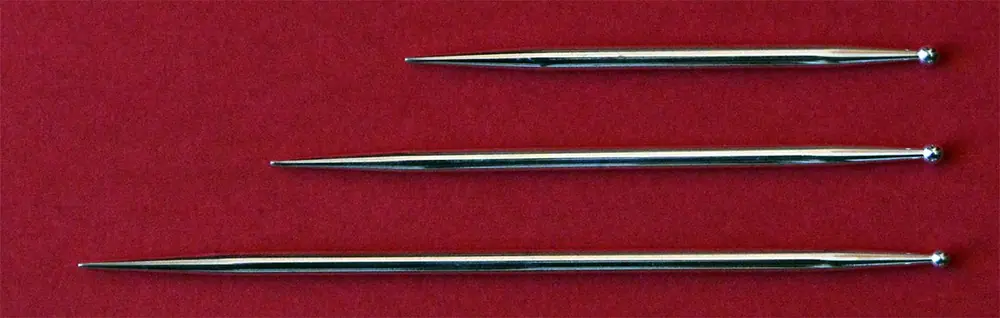
The teishin (鍉鍼) is an acupuncture tool that does not pierce the skin: a metal rod that is rested or pressed on points and meridians. It is one of the nine classical needles of Chinese medicine and one of the basic tools of toyohari.
One of the nine classical needles
The first chapter of the Lingshu, one of the founding texts of acupuncture, describes nine needles. The teishin is the third: its tip is “like a grain of millet” and it is used to press on the vessel without sinking into the skin. The second, the enshin, has an egg-shaped tip and is used by rubbing the skin; today it is also made as a tool in its own right.
In Japanese it is read teishin (ていしん), and Japanese catalogues often write it as てい鍼.
The teishin in toyohari
Toyohari is a Japanese style of meridian therapy in which most techniques are non-insertive. In the training of the European Branch of the Toyohari Association (EBTA), the teishin is used for a range of techniques, alongside contact needling. Those techniques are taught on the courses of the EBTA and its national branches.
Parts and sizes
A teishin has a cylindrical body that tapers towards the tip and, on almost all my models, a small ball at the other end. It is described by three measurements: length, body thickness and ball diameter. These are the sizes I make:
| Model | Size | Metals | Price |
|---|---|---|---|
| Teishin | 55 × 1.5 mm · ball Ø 1.5 mm | 925 silver, Copper, 750 gold, 999 platinum, 5 metals (Pt, Au, Ag, Cu, Ni) | from €45 |
| Teishin | 70 × 1.5 mm · ball Ø 1.5 mm | 925 silver, Copper, 750 gold, 999 platinum, 5 metals (Pt, Au, Ag, Cu, Ni) | from €54 |
| Teishin | 55 × 2.5 mm · ball Ø 2 mm | 925 silver, Copper, 5 metals (Pt, Au, Ag, Cu, Ni) | from €70 |
| 70 × 2.5 mm · ball Ø 2 mm | 925 silver, Copper, 5 metals (Pt, Au, Ag, Cu, Ni) | from €78 | |
| 90 × 2.5 mm · ball Ø 2 mm | 925 silver, Copper, 5 metals (Pt, Au, Ag, Cu, Ni) | from €90 | |
| Teishin | 55 × 3.5 mm · ball Ø 2.5 mm | 925 silver, Copper | from €84 |
| 75 × 3.5 mm · ball Ø 2.5 mm | 925 silver, Copper | from €90 | |
| Teishin | 55 × 4 mm · ball Ø 3 mm | 925 silver, Copper | from €82 |
| 75 × 4 mm · ball Ø 3 mm | 925 silver, Copper | from €95 | |
| Teishin Yanagishita | 95 × 3.5 mm · ball Ø 2.5 mm | 925 silver, Copper | from €105 |
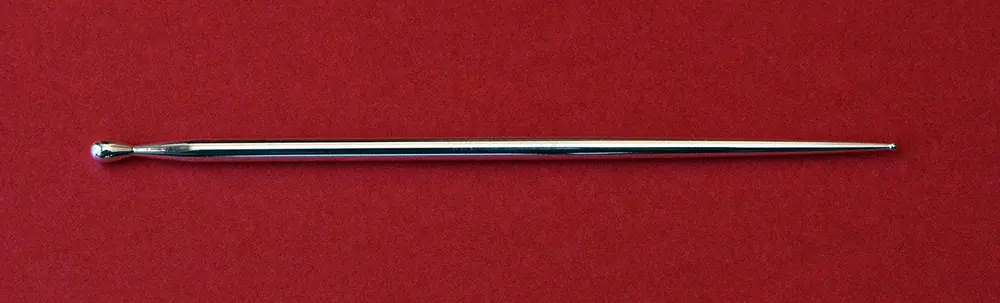
| Teishin Drop | 100 × 3 mm | 925 silver, Copper | from €155 |
Two models have their own names. The Yanagishita is named after Toshio Yanagishita, one of the Japanese teachers who brought toyohari to the West and supreme adviser to the Tōyō Hari Igakkai. The Drop is a 100 × 3 mm teishin.

How to choose
- If you already use a teishin and it suits you, the simplest option is to start from its measurements: send them to me and I will make it the same or with any changes you want.
- Length and thickness: in the same metal, a longer or thicker teishin is heavier. They range from 55 to 100 mm in length and from 1.5 to 4 mm in thickness.
- Metal: it changes the colour, the weight and the price. I explain this in the guide on choosing a metal.
- Two tools in one: the enteishin combines a finer teishin end and a rounded enshin end.
If you can't decide between two sizes, write to me through the contact form and tell me how you work.
See catalogue and prices Place an order