Handmade toyohari and shonishin tools from Barcelona
I'm Xavier Domènech, a jeweller. Since 2002 I have been making teishin, enshin, zanshin and shonishin tools by hand for acupuncturists across Europe and beyond.
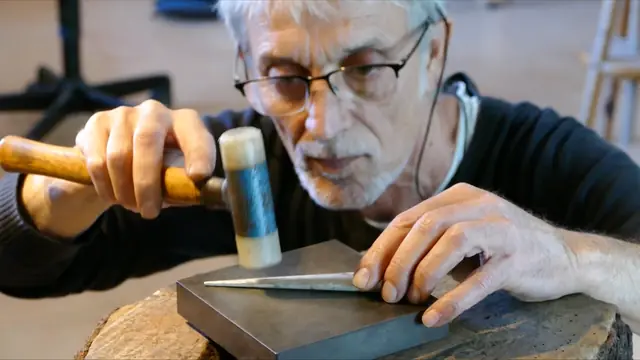
Every tool passes only through my hands, from casting the metal to the final polish. I work in silver, gold, platinum, copper and a five-metal alloy of my own, and I also make tools to order.
The tools
Teishin
One of the nine classical needles described in the Lingshu. It does not pierce the skin: in toyohari it is used for a range of contact techniques.
from €45
Enteishin
A combination tool: a finer teishin end and a rounded enshin end.
from €100
Zanshin
A trumpet-shaped shonishin instrument, used without piercing the skin.
from €180
Enshin
A rod with a spherical end that is slid, rubbed or pressed on the skin, without insertion.
from €150
Shonishin
Instruments for shonishin, Japanese paediatric acupuncture: very light contact, without insertion.
from €85
How they are made
Background
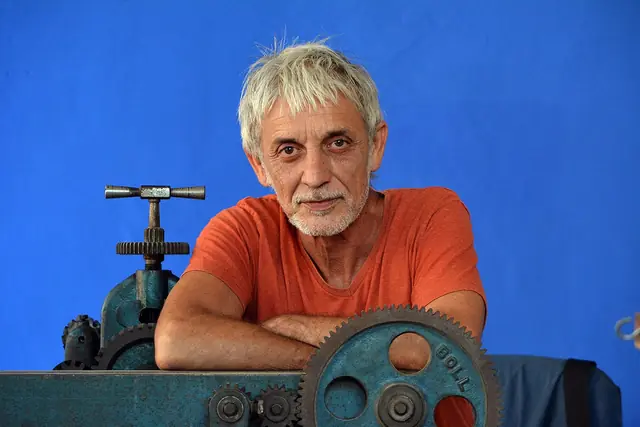
I have worked in contemporary jewellery since the 1980s. I trained at the Escola Massana in Barcelona, where I later taught jewellery design, and I have exhibited in Europe, the United States and Canada. My work is in the collections of the Victoria and Albert Museum in London, the Montreal Museum of Fine Arts and the Museu del Disseny de Barcelona.
In 2002, Stephen Birch, now Academic Dean of the European Branch of the Toyohari Association, and Miguel Ángel Cabrer asked me to make toyohari and shonishin tools for them. Since then, my work has become known by word of mouth among acupuncturists themselves.
Guides
What is a teishin? Origins, use in toyohari and how to choose one
The classical needle that does not pierce the skin: where it comes from, how it is used in toyohari and how to choose size and metal.
Shonishin tools: zanshin, Yoneyama and enshin
What shonishin is and which tools it uses: trumpet zanshin, Yoneyama and enshin.
Which metal for a teishin? Silver, gold, platinum or copper
What changes between silver, gold, platinum, copper and the five-metal alloy: composition, weight, care and price.
What is toyohari? Japanese meridian therapy and its tools
The Japanese meridian therapy I began making tools for in 2002: its origins, its presence in Europe and its tools.
Frequently asked questions
Which tools do you make?
Teishin in several lengths and thicknesses (including the Yanagishita and the Drop), enteishin, zanshin, enshin and shonishin tools such as the Yoneyama. I also make tools to order, in other metals, shapes and sizes.
Which metals do you use?
925 silver, copper, 750 gold, 999 platinum and a five-metal alloy of my own (silver, gold, platinum, copper and nickel), which I use mainly for teishin. Other metals on request.
What is special about the 5-metal alloy?
I developed it myself for making teishin. The acupuncturists who work with it value it highly and say it has very particular harmonising qualities. It contains nickel, so if you are allergic to nickel, choose another metal.
Are they really handmade?
Yes, one at a time and with no industrial processes: from casting the metal to polishing, every piece passes only through my hands. That is why dimensions may vary by a few hundredths of a millimetre, without affecting how the tool works.
Do prices include VAT and shipping?
No. Prices exclude 21% VAT and shipping, which is calculated for each order.
Do you ship outside Spain? Are there customs charges?
Yes, I ship all over Europe and to other countries. There are no customs within the European Union, except for shipments to the Canary Islands. Outside the EU (for example the United Kingdom or Switzerland), the recipient may have to pay import VAT and the carrier's handling fee.
How do I place an order?
In the catalogue, press “Add to order” on each size you want, then “Review and send”. In the form you choose the metal and quantity for each tool (you can add more under “Add tools”), fill in your details and shipping country, and press “Send”. You don't pay anything at that point: I reply with the final amount and the shipping cost.
Can I try the tools before buying?
Yes, at the toyohari workshops held every year in different European cities, where I show my work. Anyone who buys or orders a tool there may get a discount or avoid shipping costs.
Contact
For orders, quotes or tools made to order, write to me using this form and I will reply as soon as possible.
Barcelona, Spain